
Horses of Hoofprint Bay: Foal Training & Daily Care
Learn Horses of Hoofprint Bay foal training, the age-12 adult milestone, mare-and-foal walks, and how to manage daily exercise.
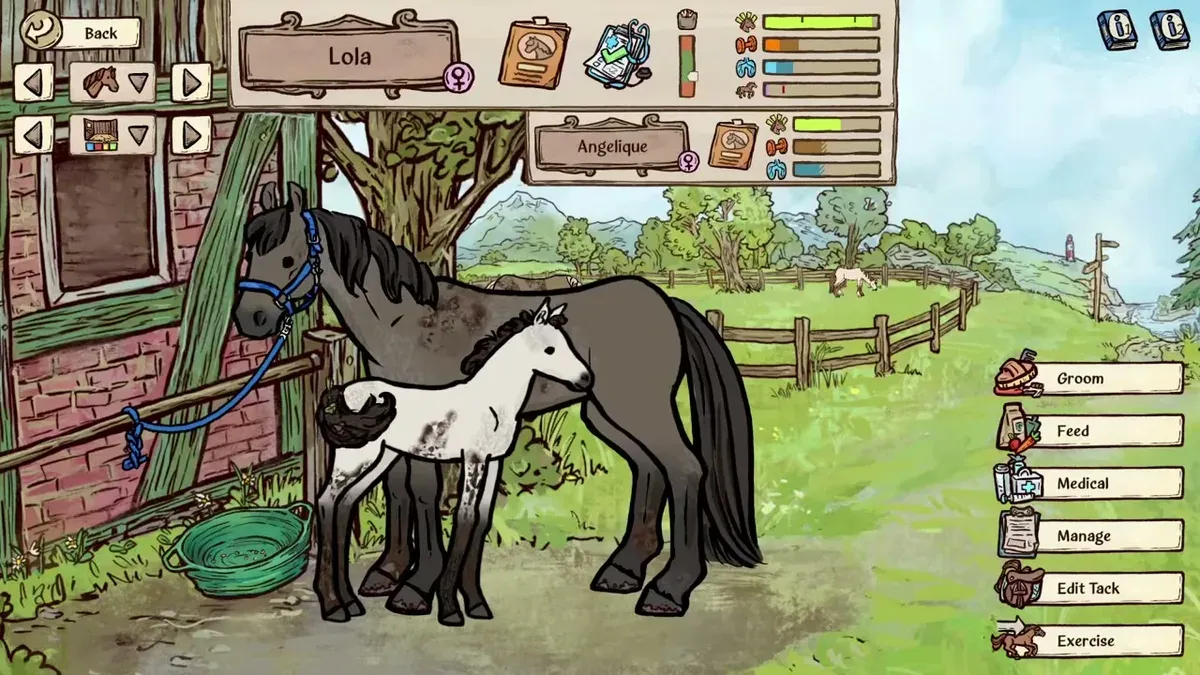
Start with the foal’s growth timeline
Your foal can accompany its mother on walks, and it reaches adulthood at age 12 in-game days. Horses of Hoofprint Bay foal training becomes easier to plan once you understand the four-day nursing stage and the roughly eight-day yearling stage. This Horses of Hoofprint Bay foal training guide explains those milestones, the confirmed walking activity, and the workload limits that help you care for the mare.
Version covered: Global Steam full release, launched November 4, 2026; information current as of November 5, 2026.
The in-game Breeding book visible in Rohara’s full-release recording at 1:15:25 gives the pregnancy and growth schedule:
| Stage | Confirmed timing | What to plan around |
|---|---|---|
| Pregnancy | Eight in-game days | The mare’s work restrictions change halfway through |
| Nursing foal | First four days after birth | The foal stays with its mother |
| Yearling | Approximately age four through age 12 | Allow roughly eight days for this stage |
| Adult | At age 12 days | Recheck the horse’s available activities after the transition |
Age 12 is the horse’s total age after birth. The yearling stage does not add another 12 days after the initial four days with the mare.
For example, when your horse becomes a yearling around age four, the remaining interval to adulthood is approximately eight in-game days. Keep pregnancy duration separate from the offspring’s age when planning your breeding schedule.
These are game days, or turns. The word “yearling” names a growth stage; it does not mean you must wait a real-world year.
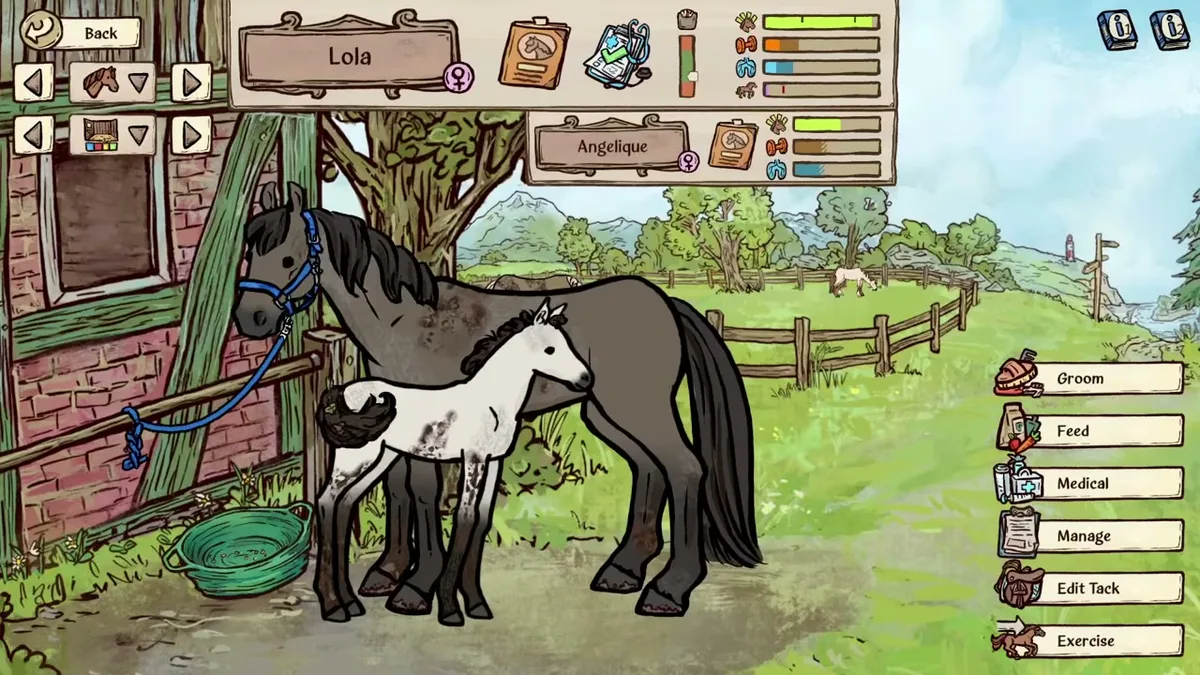
Game reference image. Image source.
Full-release gameplay and in-game handbook: Horses of Hoofprint Bay FULL RELEASE! Starting Our Horse Stable! 🐎 — Rohara, November 4, 2026. English-language reference footage. Specific handbook claims link to their observed timestamps; other uses are general game reference, not a device benchmark or proof of a bug fix.
Take the nursing mare and foal on walks
The confirmed early activity for foal training is accompanying the mother on a walk. The official walking and desensitization announcement identifies the arena and forest as walking locations and explains that nursing mares bring their foals along.
The practical starting point is the mare. Choose her for the walking activity, with the foal accompanying her during its nursing stage.
| Step | What to do | What the evidence establishes |
|---|---|---|
| Choose the horse | Select the nursing mare for a walk | Nursing mares bring their foals |
| Choose the setting | Use the walking option in the arena or forest | Both locations support walks |
| Watch the workload | Check the mare’s exercise before adding more activity | Daily exercise has an exhaustion threshold |
| Reassess after growth | Check available activities when the foal becomes a yearling | The nursing stage lasts four days |
Walking gives you an activity to share with the mare and foal while the youngster is still beside its mother. It also fits the broader need to keep pregnant and nursing mares appropriately active.
However, exact foal stat gains from these walks remain unverified. There is no confirmed confidence reward per outing, strength gain per lap, or daily walking quota for newborn foals.
That distinction matters when deciding how to spend a day. Take the pair out because walking is an available activity, then judge additional work against the mare’s condition and exercise allowance. Repeating walks solely to chase an assumed foal bonus has no established payoff.
Adjust the mare’s work during pregnancy and nursing
A useful foal training routine includes the mother’s changing workload. Her eight-day pregnancy has two halves, and the Breeding book describes different restrictions for each.
| Period | Confirmed activity rule | Practical implication |
|---|---|---|
| First half of pregnancy | Normal work is permitted | Continue checking exercise and condition |
| Second half of pregnancy | Riding is unavailable; lunging is permitted | Use permitted activity without expecting strength or endurance gains from lunging |
| Nursing period | The mare can go walking with her foal | Include suitable exercise while monitoring her workload |
The late-pregnancy lunging rule explains a potentially confusing result: a permitted activity can provide exercise without increasing strength or endurance. A session showing no gain during that period does not, by itself, indicate a broken training system.
The in-game Horse Stats & Training book, visible in Rohara’s recording at 33:00, also explains that pregnant and nursing mares lose strength and endurance. Some exercise reduces that loss.
Think of this period as managing the mare’s fitness through pregnancy and nursing. Reduced loss is useful even when the activity does not produce the improvement you would normally seek from training. It also means that complete inactivity is not automatically the best response to pregnancy restrictions.
Before choosing another activity, consider three things together:
- Whether the mare’s current stage permits it.
- How much exercise she has already accumulated.
- Whether her body condition calls for adjustments to workload or feeding.
The handbook also permits breeding a mare again while she is nursing. That makes overlapping breeding cycles possible, but the activity restrictions and fitness changes still need attention. Breeding availability does not remove the need to manage her daily care.
Yearlings and confidence in foal training
At approximately age four, the foal becomes a yearling. Start this stage by checking which activities the game enables for that particular horse.
A complete, verified full-release list of yearling training courses and their individual stat rewards is unavailable. Avoid building a rigid schedule around an assumed number of lunging sessions or confidence exercises. Let the selected horse’s available activities determine what you can actually attempt.
When Confidence Training is available, the full-release tutorial demonstrates a clear approach. The handler is on foot, leading the horse with a rope, and responds to its reaction to a frightening object.
| Situation | Tutorial response | Control shown |
|---|---|---|
| The horse is curious at its current distance | Praise the horse | S |
| The horse remains curious as you progress | Approach gradually and continue observing | No additional key specified here |
| The horse becomes worried | Back away and give it space | A |
These controls and reactions appear in the Confidence Training tutorial at 1:03:20. Follow your own displayed prompts if your controls differ.
The useful habit is to watch the reaction before deciding whether to move closer. Find a distance where the horse shows curiosity, praise that response, and advance gradually. When worry appears, increase the distance instead of continuing forward.
This tutorial establishes how the course works. Eligibility still needs a separate check; a newborn accompanying its mother on a walk is not proof that it can enter the confidence course independently.
Community reports: Players discussing the February demo described rapid confidence gains from praising immediately after requested gait changes. Those February demo player experiences predate the later confidence overhaul. They do not establish a current foal-specific shortcut.
For foal training, prioritize the current activity options and tutorial reactions over an older promise of fast confidence gains.
Build a daily routine around exercise and body condition
The daily management side of foal training becomes more useful when you distinguish exercise, endurance, and body condition. These measures describe different things, so a change in one does not necessarily explain a change in another.
The Horse Stats & Training book describes the exercise bar as work already used that day. Crossing its red threshold causes exhaustion the following day. Higher endurance allows more daily exercise, which makes copying another horse’s schedule a poor starting point.
| Measure or condition | What it means in the handbook | How to use it |
|---|---|---|
| Exercise bar | Tracks work used today | Check accumulated work before another activity |
| Red exercise threshold | Passing it causes next-day exhaustion | Stop before exceeding the threshold |
| Endurance | Higher endurance permits more daily exercise | Plan around the individual horse |
| Overnight field time | Counts as some exercise | Include turnout when considering daily activity |
| Body condition | Reflects weight; work lowers it and grain restores it | Adjust care according to the horse’s condition |
Insufficient exercise can produce an explosive state. If that state appears, review activity levels alongside confidence rather than assuming every behavior problem has the same cause. Overnight field time contributes some exercise, but the handbook does not supply a universal turnout amount that guarantees sufficient activity for every horse.
Body condition needs its own check. Work reduces weight, while grain helps restore it. At the extremes, horses can become malnourished or overweight, with laminitis associated with excessive weight. A fixed grain prescription for every mare or youngster is therefore unsupported.
A practical routine is to review the horse’s age and reproductive stage first, choose an eligible activity, and then check exercise before adding another session. Review body condition separately so feeding decisions respond to weight rather than to an assumed training bonus.
As the youngster approaches age 12, prepare to reassess its available activities. Adulthood is a growth milestone, not a promise that the horse already has the strength, endurance, or confidence needed for every challenge.
There is no verified “perfect foal” schedule with a guaranteed number of sessions. The actionable information is the growth timeline, the mare-and-foal walking option, the confidence tutorial’s reactions, and the daily exercise limits.
FAQ
How long does foal training take?
There is no verified fixed duration for completing foal training. The growth schedule is confirmed: the foal stays with its mare for four in-game days, becomes a yearling, and reaches adulthood at age 12. That leaves approximately eight days between the yearling transition and adulthood.
Do walks increase a newborn foal’s stats?
A nursing foal can accompany its mother on walks in the arena and forest. Exact strength, endurance, or confidence gains for the foal have not been verified. Walking availability alone does not establish a stat reward, so there is no supported number of laps to recommend.
Can a mare breed again while nursing?
Yes. The Breeding book shown in the full-release recording says a mare may be covered again while nursing. Continue monitoring her exercise and body condition, and remember that pregnant and nursing mares can lose strength and endurance even when some exercise reduces the loss.
Why does my pregnant mare get no gains from lunging?
During the second half of the eight-day pregnancy, lunging remains permitted but does not produce strength or endurance training gains. The training handbook separately explains that some exercise reduces pregnancy-related stat loss. A session can therefore have a maintenance benefit without increasing those stats.
What should you read next?
- Horse Care & Grooming Guide
- Horse Breeding & Genetics
- Foal Growth & Age Milestones
- Horse Personality Traits Explained
Return to Horses & Breeding or the wiki homepage to choose another topic.
Related Articles
guides
Horses of Hoofprint Bay: Steam Achievements Guide
Plan Horses of Hoofprint Bay achievement goals across breeding, training and competition wins. Find confirmed milestones and help with disabled achievements.
horses
Horses of Hoofprint Bay: Foal Growth & Age Milestones
Foals become yearlings in 4 in-game days and adults at age 12. Plan pregnancy, mare training, and stable space with the full-release timeline.
horses
Horses of Hoofprint Bay: Horse Age, Growth & Retirement
Understand horse age in Horses of Hoofprint Bay: eight-day pregnancy, foals becoming yearlings at four days, adulthood at age 12, and retirement guidance.
Was this helpful?
Thanks for the feedback!