
Horses of Hoofprint Bay: Yearlings: Housing & Eligibility
Learn when yearlings become adults, how to plan paddock and stable space, and what to check before buying or training young horses.
When does a yearling become an adult?
Your Horses of Hoofprint Bay yearling becomes an adult at age 12 in-game days, so its next housing arrangement may be closer than you think. The yearling stage begins at age four, giving you approximately eight game days to prepare adult space. A Horses of Hoofprint Bay yearling purchased at age six therefore has about six game days remaining before adulthood.
The game measures horse ages in in-game days, or turns. Waiting for real-world hours to pass is not the relevant measure, and the word “yearling” does not require converting the displayed age into calendar years.
For the global Steam full release launched November 4, 2026, the Breeding handbook shown in Rohara’s full-release recording gives the following milestones. These are handbook statements visible in the recording, rather than firsthand gameplay observations.
| Milestone | In-game timing | What it means for planning |
|---|---|---|
| Pregnancy | Eight game days | This occurs before the offspring’s age begins |
| Foal with its mare | First four days after birth | Prepare for the upcoming yearling stage |
| Yearling | From age four until adulthood at 12 | Allow approximately eight days for this stage |
| Adult | Age 12 days | Check adult housing and available activities |
The distinction is 12 days of total age, rather than another 12 days after becoming a yearling. Adding four foal days and 12 yearling days would overestimate the wait.
Also keep the horse’s age separate from your save’s day number. A farm on day 30 can contain horses of different ages. For scheduling, the useful number is the individual horse’s displayed age; the farm calendar alone cannot tell you how close it is to adulthood.
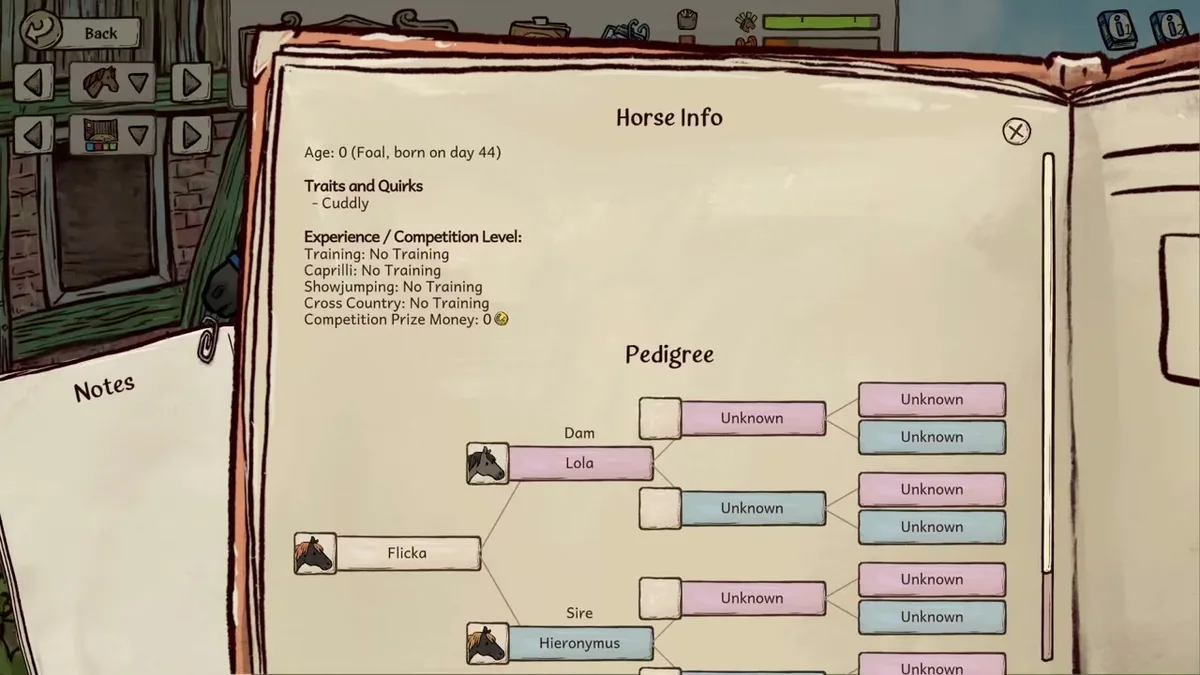
Game reference image. Image source.
Full-release gameplay and in-game handbook: Horses of Hoofprint Bay FULL RELEASE! Starting Our Horse Stable! 🐎 — Rohara, November 4, 2026. English-language reference footage. Specific handbook claims link to their observed timestamps; other uses are general game reference, not a device benchmark or proof of a bug fix.
Plan your yearling housing
Plan around two space checks: accommodation during the yearling stage and accommodation after the horse reaches adulthood. Buying several youngsters close together can concentrate those housing decisions into a short period.
The developers describe a dedicated yearling paddock alongside the adult stable. However, the exact maximum yearling capacity in the November 4 full release is not confirmed by the available launch evidence. Check the capacity shown in your current game before buying or breeding toward a particular herd size.
| Planning point | What to check | Why it matters |
|---|---|---|
| Before acquiring a youngster | Available young-stock accommodation | A planned purchase needs somewhere to go |
| During the yearling stage | Each horse’s age and future adult space | Several horses may mature close together |
| Before expanding the herd again | Current occupancy, upgrade information, and care budget | Today’s spare space may already be needed by growing horses |
A May 27 developer update about buildings and horse capacity proposed room for 13 yearling and 20 adult horses at full upgrades. The developers explicitly described those numbers as subject to change. They are historical targets, not verified launch limits. An eight-place yearling figure likewise should not be presented as an established full-release maximum.
Use the current housing display to make decisions instead of assuming either quoted yearling count applies to your save. The breeder’s sale screen also cannot establish your own paddock capacity simply because it displays several youngsters.
A practical approach is to note which horses are closest to age 12 before adding another purchase. Reserve room in your plans for those animals first. If adult accommodation is tight, review your expansion or boarding options before the transition.
Older Playtest notes addressed problems involving yearling growing up and housing availability. Those fixes do not establish a guaranteed automatic overflow arrangement for your current horses, so avoid relying on the game to resolve a full stable in a particular way.
Check activity and breeding eligibility before making plans
For a yearling, the confirmed age milestone is adulthood at 12 days. The available launch evidence does not establish a complete activity-by-activity list covering yearling riding, lunging, walking, training gains, and breeding eligibility.
That matters when an action is unavailable. A horse appearing for sale does not establish that it qualifies for every activity, and an equipment option alone does not demonstrate riding eligibility.
Use these checks when selecting a youngster:
- Read its current life-stage label. Confirm whether the game still identifies it as a yearling.
- Inspect the desired activity. Read any disabled-button explanation or tooltip before changing your plans.
- Check its displayed exercise allowance. Avoid budgeting an adult workload for a youngster.
- Recheck after adulthood. Becoming an adult is the age milestone to watch, but it does not prove every other activity requirement has been met.
The official Playtest patch history explains some older advice you may encounter. June notes reduced yearling’ available exercise. August notes included yearling tack changes and removed yearling from the breeder’s stallion list.
These are historical changes, not a verified release checklist. In particular, they do not provide a confirmed current exercise number or prove that every yearling training option works exactly as it did during testing.
For breeding plans, check the actual breeding selection screen rather than treating a purchasable young male as an available stud. For training plans, use the selected horse’s current options. This keeps your schedule tied to what the game currently permits without assuming that all horses share identical eligibility.
Buying a yearling and handling daily care
Yearlings appear among the breeder’s sale offers in the full release. The breeder screen in Rohara’s launch recording shows horses aged four and six explicitly labeled as yearling, with purchase and reservation controls visible.
Those examples help you estimate the remaining wait. The estimates below are calculated from the handbook’s adult age of 12.
| Age shown on the sale listing | Recorded life stage | Approximate time remaining to adulthood |
|---|---|---|
| Four game days | Yearling | Eight game days |
| Six game days | Yearling | Six game days |
Buying a yearling starts your ownership partway through its development. Count from its displayed age, rather than starting a fresh eight-day countdown when you acquire it.
Before purchasing, compare the horse’s age with your housing plans and care budget. The recording confirms that yearling are offered for sale; it does not establish a universal price, reservation duration, or guarantee that every purchase will be available regardless of your circumstances. Read the current transaction information before committing.
While waiting for adulthood, maintain ordinary care. The Horse Care handbook visible in Rohara’s recording of the care instructions explains the following general routines:
| Care task | Handbook-supported action |
|---|---|
| Roughage | Provide hay or access to pasture |
| Filling hay racks | Drag hay from storage into stable or paddock racks |
| Water | Use the bucket on the water tub; later upgrades provide other filling methods |
| Individual feeding | Select the horse before giving grain or treats |
| Health concerns | Disinfect superficial wounds; use the in-game vet for more serious conditions |
The handbook’s extra-grain advice concerns horses working hard enough to lose weight. It does not establish a special grain requirement simply because an animal is a yearling. Check the individual horse’s needs rather than applying an adult competition feeding routine automatically.
These routines support everyday care. They are not documented shortcuts to adulthood. Base your growth expectations on the age counter, and keep feeding decisions separate from the countdown to age 12.
What to check if a yearling seems stuck
If your yearling seems to be taking too long, first check what you have been counting. Time since purchase, total horse age, and the save’s calendar day are different measurements.
Work through the following checks before assuming that growth has failed:
- Read the horse’s displayed age. Compare that number with the adult milestone of 12 game days.
- Confirm that game days have advanced. Time spent in an activity or away from the game is not itself the same measurement as completed game turns.
- Check which edition you are playing. The October Demo has a 25-day limit; the full release allows continued play.
- Compare age with the life-stage label. A horse displaying age 12 or beyond while remaining labeled a yearling warrants checking the current Breeding book and reporting the discrepancy if it persists.
- Record the circumstances clearly. Include the displayed age, life-stage label, game version, and whether the save came from a demo when describing the issue.
The official Horses of Hoofprint Bay FAQ confirms the distinction between the full game’s unlimited days and demo restrictions. It also states that October Demo saves transfer to the full release, while February Demo saves do not.
Older community reports include a player experience in which a foal born on save day 13 became an adult on day 25. That is a demo-era observation, not an independent launch rule. The full-release handbook’s age-12 statement provides the clearer basis for the current growth schedule.
If the problem is an unavailable activity rather than an incorrect life-stage label, return to that activity’s requirements. The two issues need different checks.
Yearling FAQ
How long does a yearling take to grow up?
Approximately eight game days, from age four to adulthood at age 12. A purchased yearling may have less time remaining because it has already spent part of that interval growing. Use its displayed age: a six-day-old yearling has approximately six more game days before the adult milestone.
How many yearling can the paddock hold?
The current full-release maximum remains unconfirmed. The developers discussed 13 yearling places in May 2026 but marked that number as provisional. An eight-place figure is also not established as the launch maximum. Check the capacity and upgrade information displayed in your own game before planning purchases around either number.
Can you buy yearling instead of breeding them?
Yes. Full-release footage shows yearling aged four and six among the breeder’s offers, with purchase and reservation controls visible. Check the individual listing and your accommodation before proceeding. Their presence in the sales list confirms that young-stock purchases are available, but does not establish fixed prices or universal reservation terms.
Does adulthood automatically unlock every activity?
The handbook confirms adulthood at age 12, but that milestone alone does not verify every riding, training, competition, or breeding requirement. Select the newly adult horse and check the relevant activity screen. If an option remains unavailable, use its explanation to identify the remaining requirement instead of assuming the horse needs another full yearling growth interval.
What should you read next?
- Horse Care & Grooming Guide
- Horse Breeding & Genetics
- Foal Growth & Age Milestones
- Horse Personality Traits Explained
Return to Horses & Breeding or the wiki homepage to choose another topic.
Related Articles
guides
Horses of Hoofprint Bay: Steam Achievements Guide
Plan Horses of Hoofprint Bay achievement goals across breeding, training and competition wins. Find confirmed milestones and help with disabled achievements.
horses
Horses of Hoofprint Bay: Foal Growth & Age Milestones
Foals become yearlings in 4 in-game days and adults at age 12. Plan pregnancy, mare training, and stable space with the full-release timeline.
horses
Horses of Hoofprint Bay: Foal Training & Daily Care
Learn Horses of Hoofprint Bay foal training, the age-12 adult milestone, mare-and-foal walks, and how to manage daily exercise.
Was this helpful?
Thanks for the feedback!