
Horses of Hoofprint Bay: How to Praise Your Horse
Learn the praise controls, when to reward gait changes, and how to build confidence during desensitization in Horses of Hoofprint Bay.
Praise controls and confidence basics
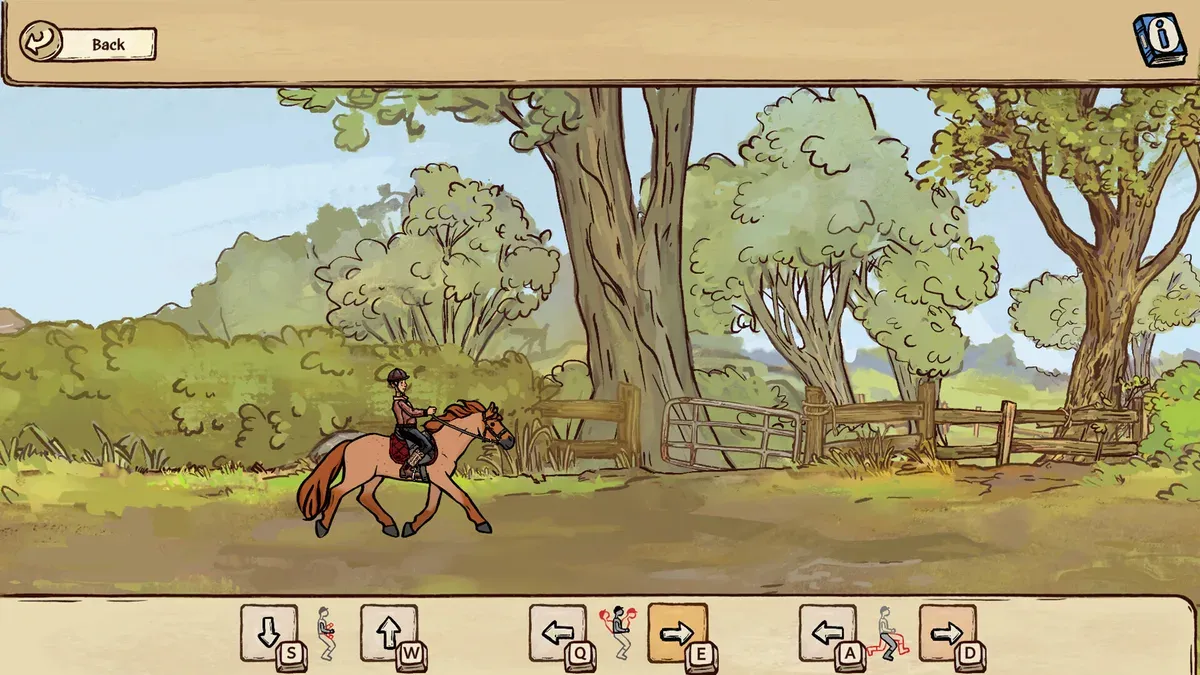
Press S or the down arrow to praise your horse with the riding bindings shown in the full release. If you searched Horses of Hoofprint Bay how to praise horse, the crucial detail is timing: praise immediately after a gait change you requested to build confidence. This Horses of Hoofprint Bay how to praise horse guide also covers rewarding curiosity in Confidence Training, where recognizing your horse’s reactions helps you approach frightening objects without pushing too hard.
Updated November 5, 2026, for the global Steam full release released November 4.
Praising your horse: control reference
The Settings/Rebind Controls screen shown in Rohara’s full-release recording displays these riding bindings:
| Action | Displayed keyboard bindings | Practical use |
|---|---|---|
| Praise | S or down arrow | Reward an appropriate response |
| Faster | D or right arrow | Request a faster gait |
| Slower | A or left arrow | Request a slower gait |
| Jump | Space, up arrow, or W | Give the jump command |
These controls can be rebound. If S does not match your setup, check Settings/Rebind Controls and find the Praise action. Use the binding displayed in your own game.
Praise matters because confidence affects how readily a horse responds. The in-game handbook describes low-confidence horses as slower to respond and more likely to change gaits without being asked. Rewarding a requested transition gives you a way to develop confidence while practicing riding.
Keep the actions separate in your mind: the faster or slower command asks for a change, and praise rewards the horse after it responds. Pressing praise before the transition happens misses the sequence described by the handbook.
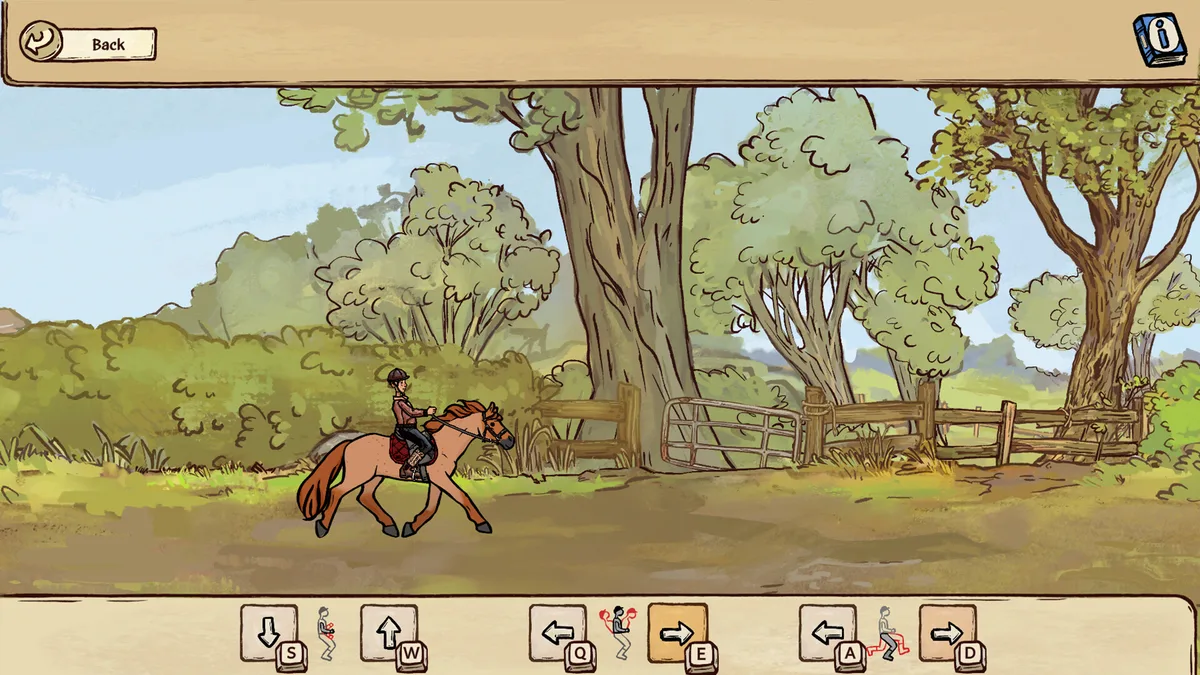
Game reference image. Image source.
Full-release gameplay and in-game handbook: Horses of Hoofprint Bay FULL RELEASE! Starting Our Horse Stable! 🐎 — Rohara, November 4, 2026. English-language reference footage. Specific handbook claims link to their observed timestamps; other uses are general game reference, not a device benchmark or proof of a bug fix.
How to time praise after a gait change
The riding routine for praising your horse is straightforward: request a gait change, wait for the horse to make it, then praise immediately.
According to the Confidence handbook visible in Rohara’s recording, praising directly after a horse changes gaits at your request raises confidence. The evidence does not establish an exact timing window in seconds, so concentrate on the completed transition rather than counting.
| Stage | What to do | What to watch |
|---|---|---|
| Request | Use Faster or Slower | You initiate the gait change |
| Observe | Watch for the horse’s response | The horse actually changes gait |
| Reward | Press your Praise binding immediately afterward | Praise follows the requested response |
For example, ask a walking horse to move into a trot. Once it makes that transition, press S if that is your assigned Praise key. A requested change to a slower gait follows the same principle: reward the response after it happens.
A slower response from a low-confidence horse makes observation especially useful. Do not assume the horse has completed your request simply because you pressed the gait control.
There is also a separate confidence-building opportunity: correcting an impending unrequested gait change. The handbook distinguishes this from praising obedience after your own request. Pay attention when the horse is about to choose a different pace, rather than treating every change as something to reward.
Likewise, jumping has its own confidence effects. Successful jumps improve confidence, while failed obstacles reduce it. A disappointing confidence result after a difficult exercise does not necessarily mean your Praise binding failed; the exercise can include both helpful and harmful events.
How to praise during Confidence Training
For praising your horse during Confidence Training, the reward cue changes: look for curiosity toward the scary object.
The full-release Confidence Training tutorial shown by Rohara depicts a handler on foot leading the horse with a rope. Its prompts explicitly show Praise: S and Back up: A. This exercise asks you to manage distance and reactions as you approach the object.
The handbook’s desensitization guidance connects curiosity with a lowered, inspecting posture and a distinctive snort. A worried, tense horse needs more space.
| Horse’s reaction or situation | Your response | Reason |
|---|---|---|
| Curious, with a lowered inspecting posture and distinctive snort | Praise | Reward its willingness to investigate |
| Worried or tense | Back away | Reduce pressure before approaching again |
| Ready for another gradual approach | Move closer while watching its reaction | Find a distance where curiosity is possible |
| Successfully passes the scary object | Recognize this as confidence progress | Passing the object can build confidence |
Work through the exercise in small decisions:
- Approach while watching the horse.
- Find a distance where it shows curiosity.
- Praise that curious response.
- Continue approaching gradually.
- Back away if the horse becomes worried.
Do not use a snort alone as your entire decision rule. The handbook describes a distinctive sound together with curious body language. Read the posture and the situation as well.
If the horse becomes tense, continuing to push forward may cause it to bolt. Backing away is part of the training method. Your next goal is to recover a distance where the horse can investigate again.
This is why repeatedly pressing S cannot replace watching the animal: the useful reward depends on what the horse is doing when you give it.
Why praise or scritches may seem ineffective
A common praising your horse mix-up is treating riding praise, favorite-spot scritches, and treats as interchangeable confidence rewards. The handbook gives them different conditions.
Riding praise depends on the requested transition and its timing. Scritching a favorite spot and giving treats can raise confidence only while it is below the upper marker described in the handbook.
| What you notice | What to check | Supported explanation |
|---|---|---|
| S seems to do nothing | Your current Praise binding | Controls can be rebound |
| Praise follows a gait change without a clear benefit | Whether you requested the change and praised directly afterward | The handbook links the reward to that sequence |
| The horse gets tense near an object | Its posture and distance from the object | Worried horses need space |
| Scritches stop improving confidence | Confidence relative to the upper marker | Favorite-spot scritches have a confidence limit |
| Confidence falls during jumping | Whether obstacles were failed | Failed obstacles reduce confidence |
Start with the simplest check: confirm the control. Then try the documented sequence during a requested gait transition, watching the horse respond before praising.
If you are working near a scary object, reassess its reaction. The instruction to praise curiosity does not mean that praise should be used to push through every sign of worry.
For scritches, the upper marker matters. A horse with high confidence can stop gaining confidence from scritches without being ill. That observation concerns the stat benefit; it does not establish why every apparently healthy horse might dislike being touched.
Avoid assigning an unsupported numeric cutoff to that marker. The verified handbook observations support the existence of a limit, but they do not provide a reliable number for this guide.
The same restraint applies to praise timing and reward size. There is no verified number of seconds, confidence points per press, or required repetitions here. Focus on the conditions the game describes.
Building confidence and interpreting older advice
The useful full-release approach to praising your horse combines rewarding requested gait transitions, correcting impending unwanted changes, successful jumping, and appropriate Confidence Training.
Each method addresses a different situation. Praise fits a horse responding to your riding request. Desensitization fits a horse investigating something frightening. Favorite-spot scritches and treats help while confidence remains below their upper marker.
There is no supported universal schedule for reaching maximum confidence. Nor is there evidence here that one method always produces the fastest result for every horse.
Player experience from the February demo: contributors in the Steam discussion about gait correction and praise described quick confidence gains from praising after gait changes. That discussion concerns the older demo, so its claims about speed should not be treated as full-release expectations.
The current handbook independently supports the requested-transition praise mechanic. That gives you a firm basis for using the technique without carrying over every older claim about how rapidly it works.
Community reports from November 4: replies to a player describing bucking and jump refusals recommended confidence training. Those replies are player advice, not proof that low confidence explains every refusal or difficult behavior.
If jumping itself remains a barrier, the official Horses of Hoofprint Bay FAQ recommends trying easier competition settings and the auto-jump accessibility option. These are options for adjusting difficulty; they do not replace learning the circumstances in which praise builds confidence.
FAQ
Praising your horse: which key should I press?
Use S or the down arrow with the riding bindings shown in the full-release recording. The Confidence Training tutorial specifically shows S for Praise. Because bindings can be changed, check Settings/Rebind Controls if your game behaves differently.
When should I praise after changing gait?
Praise immediately after the horse completes a gait change you requested. First give the faster or slower command, then watch for the actual transition. The verified handbook guidance does not establish an exact number of seconds for the reward window.
Should I praise a frightened horse near a scary object?
Praise when it shows curiosity, including the lowered inspecting posture and distinctive snort described by the handbook. If it looks worried or tense, back away and give it space. Pushing forward while it is worried can cause it to bolt, so approach gradually as its reactions allow.
Why have scritches stopped raising confidence?
Favorite-spot scritches and treats increase confidence only below the handbook’s upper marker. A horse that has reached that threshold may stop receiving confidence gains from those interactions. That alone does not indicate illness, and it does not explain every case of a horse disliking touch.
What should you read next?
Return to Training & Lessons or the wiki homepage to choose another topic.
Related Articles
training
Horses of Hoofprint Bay: Horse Training & Confidence Guide
Build strength, endurance, and confidence with practical guidance on desensitization, praise, gait warnings, and community reports about bucking.
training
Horses of Hoofprint Bay: Jump Indicator & Takeoff Help
Understand jump markers, strength warnings, riding controls, and gait choices, with full-release guidance and clearly labeled demo tips.
training
Horses of Hoofprint Bay: Jumping Timing, Gaits & Strength
Learn which gaits suit high and wide jumps, how to practice takeoff timing, and when strength or horse potential is causing missed fences.
Was this helpful?
Thanks for the feedback!