
Horses of Hoofprint Bay: Horse Personality Traits Explained
Understand horse personality traits, find the library reference, and make informed care and breeding choices in Horses of Hoofprint Bay.
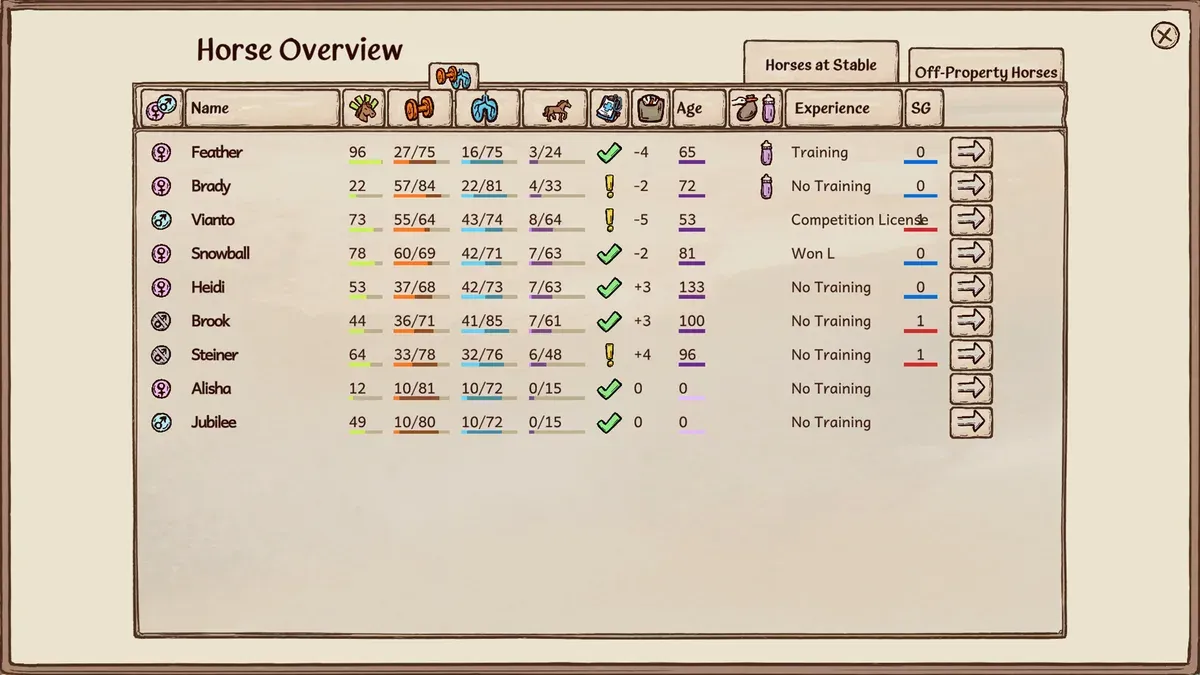
Image: official Steam catalog screenshot. Source: verified Steam listing.
Watch the related YouTube video: Horses of Hoofprint Bay – OUT NOW — thogli studios.
Official launch trailer used as general reference for the full game. It is not a dedicated tutorial, device benchmark, or proof of an individual mechanic.
What horse personality traits affect
Horses of Hoofprint Bay horse personality traits can help explain why two horses need different amounts of care or attention under saddle. Those differences matter when choosing a horse, planning breeding, or wondering why full confidence hasn’t stopped every unexpected gait change. This guide explains what is confirmed about Horses of Hoofprint Bay horse personality traits, where players report finding their descriptions, and how to use that information without guessing at hidden bonuses.
The game’s full release arrived on November 4, 2026, according to the official Horses of Hoofprint Bay Steam listing. This source-review draft covers information available through November 5, 2026; it is not based on firsthand playtesting, and no numeric patch version is verified.
The developers describe traits as individual tendencies within existing systems. Their examples cover cleanliness, susceptibility to injury, and occasional changes of gait. The intended differences are modest, giving you another reason to consider which horses suit your stable.
| Area affected | Developer-described tendency | Practical consideration |
|---|---|---|
| Cleanliness | Some horses become dirty faster than others | Check each horse’s condition when planning grooming |
| Injury susceptibility | Horses can be more or less prone to injuries | Consider the trait description alongside current condition |
| Gait behavior | Some horses occasionally change gait independently, even at full confidence | Keep watching the horse during riding after confidence improves |
These examples come from the official developer update about personalities and training. That announcement predates release; the launch-day publisher Q&A confirms that personality traits and desensitization training were added for the released game.
The available evidence establishes these broad effects, but it does not provide a complete trait catalog or exact modifiers. Read horse personality traits as descriptions of tendencies, then consult the current in-game reference before assigning a specific effect to a named characteristic.
Where to find trait descriptions in the library
The most useful place to investigate horse personality traits is the in-game library. The official store confirms that the library contains information about game systems and horses, while community reports identify a dedicated traits and characteristics book.
In the supplied community discussion about traits and characteristics, players say the book appears in the house library a few in-game days into progression. They also report that checking on day one may be too early.
That timing is community-reported player experience. The cited official material does not establish an exact unlock day or prerequisite.
| Name or reference | What the available evidence establishes | What still needs checking |
|---|---|---|
| Rebellious | A player reports seeing this trait on horses | Its current description and specific effects |
| Bad Inheritance | A player reports seeing this characteristic | What it affects and how its effect works |
| Traits and characteristics book | Community reports place it in the house library after some early progression | The precise unlock timing |
Neither trait name is enough to establish a mechanic. For example, the supplied discussion does not prove that Rebellious is the trait responsible for independent gait changes. Likewise, Bad Inheritance should not be assigned a breeding percentage or stat penalty based on its wording.
A useful reference routine is:
- Note the exact trait or characteristic shown for your horse.
- Look for its entry in the library’s traits and characteristics book.
- Read the full explanation before changing your care or breeding plans.
- If the book is absent at the beginning, check again as you progress, following the community-reported timing.
The forum replies point you toward a reference location; they do not reproduce the book’s explanations. That distinction matters when a familiar-sounding name tempts you to fill in the missing details yourself.
Why full confidence may not stop every gait change
One useful distinction in horse personality traits is the difference between improving confidence and managing an individual quirk.
The developer update discusses confidence training and personality-driven gait changes separately. It specifically describes some horses changing gait on their own despite having full confidence. An unexpected slowdown or acceleration therefore does not, by itself, establish that confidence training failed.
The same update describes a warning icon before an unprompted gait change, giving the rider an opportunity to respond. It also introduces desensitization exercises built around approaching something the horse finds frightening and observing its reactions.
| Situation described by the developers | Relevant system | Supported response |
|---|---|---|
| A warning appears before an independent gait change | Riding feedback | Use the warning as an opportunity to correct the horse |
| The horse shows curiosity during desensitization | Confidence training | Praise the curious response |
| The horse becomes worried during desensitization | Confidence training | Allow space and time |
| A horse changes gait despite full confidence | Personality tendencies may be relevant | Check its trait descriptions before assuming confidence is the cause |
These are qualitative descriptions from the development update. That source explicitly left final balancing open, so it does not establish a current training duration, warning window, or number of repetitions needed.
For practical decision-making, keep two questions separate: what does the horse’s confidence indicate, and what does its trait description explain? Confidence remains worth training, but the developer’s description gives no basis for expecting it to eliminate every personality-related behavior.
A single incident also cannot identify a trait’s effect. Use the book’s explanation to interpret what you observe, especially when multiple systems could be involved. This prevents an occasional gait change from becoming the basis for an unsupported diagnosis.
Choosing horses and adapting their care
horse personality traits give you another selection factor alongside the horse’s abilities and your plans for it. The developers present traits as an additional consideration when choosing horses, with relatively small behavioral differences.
A useful approach is to decide which demands you are comfortable managing. A cleanliness-related tendency may matter to someone trying to keep grooming manageable. A gait-related quirk may deserve more attention from someone who wants fewer independent changes while riding.
Those are practical interpretations of the documented tendencies, not a verified ranking of named traits.
| Your priority | Information to examine | How it can inform your choice |
|---|---|---|
| Managing grooming needs | The horse’s cleanliness-related trait description | Helps you anticipate whether it may get dirty more quickly |
| Understanding care demands | Any description concerning injury susceptibility | Adds context to condition checks and care planning |
| Managing riding behavior | Any description concerning independent gait changes | Helps you decide whether the quirk suits your riding preferences |
| Planning future foals | Both parents’ documented personality traits | Adds personality to the factors considered when pairing horses |
Traits also sit alongside the ordinary care systems. The official store describes brushing and hoof picking as ways to help prevent saddle sores and abscesses, with appropriate treatment needed when scrapes or injuries occur.
An injury-related tendency does not establish a specific treatment plan. Respond to the condition shown by the game and use its care guidance. Similarly, a horse that gets dirty quickly gives you a reason to check cleanliness regularly, but the sources do not support a fixed extra grooming schedule.
When evaluating a horse, distinguish its current condition from its described tendency. The same distinction helps when comparing two horses: a dirty horse is an observation, while getting dirty more quickly is a trait effect described by the developers.
Avoid rejecting a horse solely because a characteristic sounds unfavorable. Read what it does, consider the horse’s other qualities, and decide whether its needs fit your stable. The available material does not establish a universally best personality combination.
What personality inheritance means for breeding
Breeding is another reason to understand horse personality traits. The official store confirms that foals inherit a mixture of parental characteristics, including personality traits as well as coloring and white patterns.
That makes personality relevant when selecting a stallion and mare. However, the available evidence does not explain the inheritance formula, whether every trait can pass down, or the probability of receiving any particular combination.
A sensible planning sequence is:
- Read both parents’ trait descriptions. Use the library to establish what the characteristics mean.
- Consider personality alongside your breeding goals. The store describes planning pairings for appearance or stats, with traits also inherited.
- Keep expectations conditional. Inheritance is confirmed, but a desired combination is not guaranteed by the cited material.
The official listing also describes an advanced breeding station lab that previews possible foals. It does not specify whether that preview reveals personality traits, how detailed its predictions are, or which outcomes it can guarantee. Check what the feature actually displays before using it to make a trait-specific decision.
Bad Inheritance deserves particular caution here. Its appearance in a community question confirms only that a player reported the name. That post does not explain its effect on offspring, parental stats, or breeding outcomes.
For any pairing, the most useful evidence is the current description of each parent’s characteristics. A name that sounds connected to breeding is a reason to investigate, not enough information to calculate an outcome.
FAQ
What do horse personality traits do?
The developers describe traits as tendencies affecting existing mechanics. Examples include how quickly horses become dirty, how susceptible they are to injuries, and whether they occasionally change gait independently despite full confidence. The cited sources do not provide a complete list of named traits or numerical effects.
Where is the traits and characteristics book?
Community reports place it in the library inside your house. Players say it becomes available a few in-game days into progression and may be absent on day one. This is player experience; an exact unlock day or trigger is not confirmed in the cited official material.
What do Rebellious and Bad Inheritance mean?
Both names appear in a community question, but the supplied discussion does not explain their mechanics. Check their entries in the current in-game book. There is insufficient evidence here to attach either name to a specific gait behavior, stat penalty, or inheritance percentage.
Can foals inherit personality traits?
Yes. The official Steam listing explicitly includes personality among the characteristics foals inherit from their parents. It does not provide inheritance odds or guaranteed combinations. Consider both parents’ documented traits when planning a pairing, while keeping the difference between a possible outcome and a guaranteed one clear.
What should you read next?
- Horse Care & Grooming Guide
- Horse Breeding & Genetics
- Foal Growth & Age Milestones
- Horse Coats, Patterns & Colors
Return to Horses & Breeding or the wiki homepage to choose another topic.
Related Articles
horses
Horses of Hoofprint Bay: Foal Growth & Age Milestones
Foals become yearlings in 4 in-game days and adults at age 12. Plan pregnancy, mare training, and stable space with the full-release timeline.
horses
Horses of Hoofprint Bay: Foal Training & Daily Care
Learn Horses of Hoofprint Bay foal training, the age-12 adult milestone, mare-and-foal walks, and how to manage daily exercise.
horses
Horses of Hoofprint Bay: Horse Age, Growth & Retirement
Understand horse age in Horses of Hoofprint Bay: eight-day pregnancy, foals becoming yearlings at four days, adulthood at age 12, and retirement guidance.
Was this helpful?
Thanks for the feedback!