
Horses of Hoofprint Bay: Horse Hates Being Touched: Help
Check confidence, injuries, and care needs when your horse dislikes touch, and learn what missing green hearts actually mean.
Why your horse suddenly seems to dislike touch
If your Horses of Hoofprint Bay touch sensitivity, first distinguish missing green hearts from an actively annoyed reaction. Scritches and treats have a confidence-training limit, so recognizing that limit helps you avoid treating every missing heart as a health problem. However, if your Horses of Hoofprint Bay touch sensitivity despite a clear medical tab, the confidence limit alone does not explain the behavior.
The full-release Confidence handbook establishes that scratching a favorite spot and giving treats increase confidence only below the upper marker. It does not establish why every healthy horse might glare, toss its head, or appear to reject touch. That distinction matters when deciding what to check next.
| What you notice | What the evidence supports | Useful next step |
|---|---|---|
| Scritches stop increasing confidence | The handbook describes an upper limit for confidence gains from scritches and treats | Check the confidence bar |
| Green hearts disappear as confidence rises | Community reports describe this pattern | Compare the missing hearts with the horse’s confidence |
| The horse reacts negatively around an injury | Player experience suggests injuries can make touching or brushing unwelcome | Inspect the medical tab and affected area |
| The horse reacts negatively despite appearing healthy | The reported cause remains unresolved | Record the reaction and circumstances |
Community observations about hearts and touch come from the Steam discussion about horses suddenly disliking touch. They should be distinguished from the handbook’s confirmed confidence rules.
This guide covers the global Steam full release launched November 4, 2026, with information current to November 5.
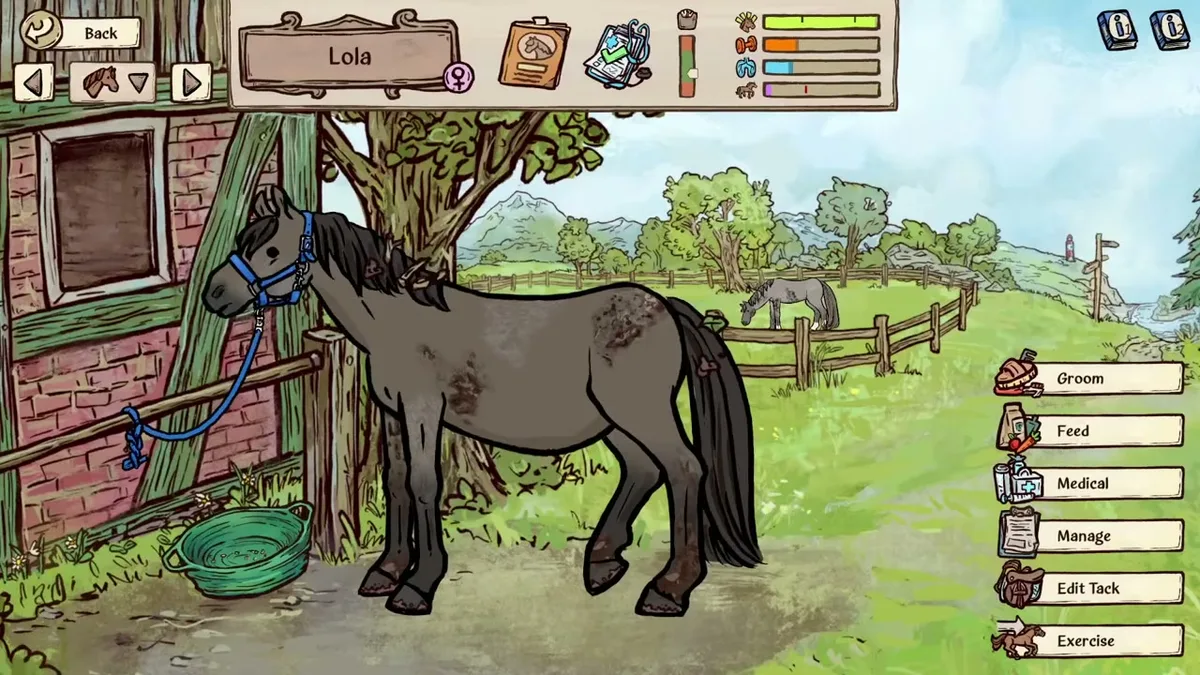
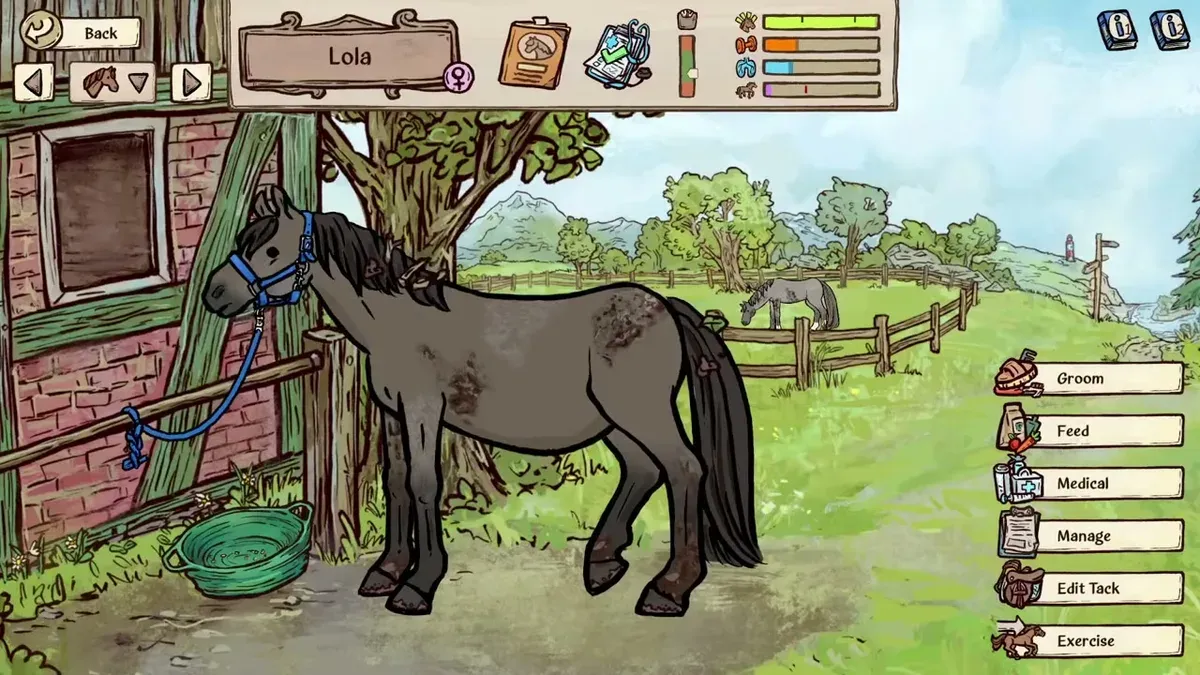
Unaltered gameplay still from JayPlays’ full-release video. General visual context, not proof of an undocumented mechanic. Image source.
Full-release gameplay and in-game handbook: Horses of Hoofprint Bay FULL RELEASE! Starting Our Horse Stable! 🐎 — Rohara, November 4, 2026. English-language reference footage. Specific handbook claims link to their observed timestamps; other uses are general game reference, not a device benchmark or proof of a bug fix.
Check the medical tab and basic care first
If your touch sensitivity and appears uncomfortable, start with the medical tab. Check whether it lists a cut, abrasion, exhaustion, or another condition before trying to solve the issue through more petting.
Player experience: A participant in the Steam discussion suggested that horses dislike brushing or petting over injuries. The original poster subsequently reported a clear medical tab, so that suggestion did not resolve their case. Checking for injuries is useful; assuming an injury must exist is unsupported.
The game’s Injuries & Illnesses handbook provides concrete responses when a condition is actually present:
| Condition shown in the game | Handbook-supported response | Relevant detail |
|---|---|---|
| Abrasion or cut | Apply the game’s antiseptic treatment | Treatment reduces infection risk |
| Dehydration | Provide water | Neglected dehydration can lead to animal welfare removal |
| Exhaustion | Allow rest and manage subsequent exercise carefully | Exhaustion reduces strength and endurance and prevents training those stats |
These are game mechanics described in the Injuries & Illnesses handbook visible in Rohara’s recording. They do not establish that dehydration or exhaustion causes the specific touch reaction.
Next, review everyday care. The Horse Care handbook says horses need roughage from hay or pasture, while horses doing substantial work need additional grain to avoid weight loss. Supply hay by dragging it from storage into the stable or paddock racks. Water can be supplied by dragging a bucket to the tub; later upgrades offer additional filling options.
Before riding, remove hoof stones, curry away dirt, and brush the saddle area smooth. The handbook assigns basic superficial wound disinfection to the player and more severe conditions to the in-game veterinarian. These instructions appear in the Horse Care handbook shown in the recording.
Use this care check to identify actual needs. A clean medical tab and adequate supplies still leave the specific reason for an annoyed touch animation unanswered.
What missing green hearts actually mean
When your touch sensitivity after several successful training days, check whether confidence has increased. A favorite scratching spot can stop providing confidence gains even when the horse is healthy.
According to the Confidence handbook visible in Rohara’s full-release recording, favorite-spot scritches and treats improve confidence only below the upper marker. Repeating either interaction after reaching that limit is therefore not a supported way to keep raising the stat.
| Interaction or observation | Confirmed meaning or limitation |
|---|---|
| Scratching the favorite spot | Can raise confidence below the upper marker |
| Giving treats | Also has the upper-marker restriction |
| No further confidence gain from scritches | Can occur in a healthy, highly confident horse |
| Missing green hearts | Community reports associate this with higher confidence |
| Glaring or tossing the head | The confidence limit does not establish the cause |
This explains why two observations need separate attention: the reward can stop, while the meaning of an annoyed animation remains uncertain.
For example, a horse that previously gained confidence from scritches may reach the upper marker after training. The handbook supports expecting that particular training benefit to stop. It does not support concluding that the horse has become injured, lost trust, or developed a new personality trait.
Community reports give a numerical threshold for disappearing hearts, but the verified handbook observation supports using the visible upper marker. An exact number is unnecessary for deciding whether to move on to another confidence exercise.
How to build confidence after scritches stop helping
If your touch sensitivity and scritches no longer increase confidence, choose another supported training activity once health and care needs are addressed. This gives you a way to progress without depending on the scratching reward.
The Confidence handbook describes several training opportunities. Successful jumps improve confidence, while failed obstacles reduce it. During riding, praise should follow a requested gait transition promptly. An impending unrequested gait change provides an opportunity for correction.
| Training situation | What to do | Timing or caution |
|---|---|---|
| The horse completes a requested gait transition | Praise the horse | Praise directly afterward |
| An unrequested gait change is about to happen | Correct the horse | Respond before the change occurs |
| The horse successfully clears a jump | Continue using successful jumping as confidence work | Failed obstacles reduce confidence |
| The horse becomes curious during desensitization | Praise its curiosity | Watch for inspection posture and the distinctive snort |
| The horse becomes worried or tense | Back away and avoid forward pressure | Pushing onward may cause a bolt |
For jumping, the practical implication is to favor obstacles you can clear consistently. Repeated failures work against the confidence you are trying to build. Increasing difficulty simply because scritches stopped helping is not required by the handbook.
Desensitization offers another route, but it requires attention to the horse’s reactions. The desensitization instructions in the recorded Confidence handbook describe curiosity through a lowered inspection posture and a distinctive snort. Praise that response.
When the horse becomes tense or worried, back away and avoid applying forward pressure. The handbook warns that pushing may cause bolting and describes a confidence gain after passing the scary object. It does not support a fixed number of repetitions that will resolve every horse’s behavior.
Low confidence can cause slower responses and unwanted gait changes, which makes these training opportunities useful. Nevertheless, successful confidence training should not be presented as a verified cure for every negative touch animation.
Also check for exhaustion before adding work. An exhausted horse needs recovery, and the injury handbook warns against exercise patterns that risk tendon damage.
Touch sensitivity: The unresolved case
The most frustrating case is a horse with high confidence, no listed injuries, and an obvious negative response to your hand. The November 4 Steam discussion specifically raises this problem.
Community reports: The original poster described a starter horse and boarders that previously appeared to enjoy a particular spot, then began showing apparent displeasure. They said confidence had improved and later clarified that the medical tab showed no problems.
That clarification matters. Explaining why green hearts disappear does not fully answer why an otherwise healthy horse appears actively annoyed. The available handbook observations do not identify a universal cause or a guaranteed fix for that combination.
For useful troubleshooting, keep track of what you can actually observe:
- Whether hearts disappear, the horse reacts negatively, or both happen.
- Whether the reaction occurs with the hand, brush, or both.
- Whether one location triggers it or it happens across the horse.
- Whether the medical tab lists a condition.
- Where confidence sits relative to the upper marker.
- Whether the same behavior occurs with other horses.
These observations help describe the problem precisely. They are not a hidden sequence for resetting affection or unlocking a new favorite spot.
If your touch sensitivity despite a clear medical tab, report the behavior with those details and identify whether you are using the full release or a demo. A short recording can show the difference between absent hearts and an active reaction.
The official Horses of Hoofprint Bay FAQ says the developers intend to monitor bug reports and minor requests. Reporting a reproducible case is reasonable, although the current evidence does not confirm that this particular behavior is a bug.
FAQ
My touch sensitivity. Does that prove confidence is low?
No. The handbook says scritches stop improving confidence at the upper marker, so an absent confidence reward can occur with high confidence. Community reports also describe negative reactions in apparently healthy, confident horses. The animation alone does not establish a low-confidence diagnosis.
Should I keep giving treats when scratching stops working?
Treats share the upper-marker restriction for confidence gains. If the horse has reached that marker, repeated treats are not a supported method for raising confidence further. Use the handbook’s riding and desensitization opportunities when the horse is fit to train.
Can cuts or abrasions explain an annoyed reaction?
Player experience suggests horses may dislike being touched or brushed over injuries. Check the medical tab before assuming that explanation applies. The handbook confirms antiseptic treatment for in-game cuts and abrasions, but the community discussion also includes a horse reported as healthy whose negative reaction remained unexplained.
Is there a confirmed fix for a healthy horse that dislikes touch?
No universal fix is established by the current evidence. Address any listed conditions, maintain routine care, and distinguish the confidence reward limit from the negative animation. If the reaction persists, document the interaction, confidence level, medical status, and game version so the unresolved behavior can be reported clearly.
What should you read next?
- Horse Care & Grooming Guide
- Horse Breeding & Genetics
- Foal Growth & Age Milestones
- Horse Personality Traits Explained
Return to Horses & Breeding or the wiki homepage to choose another topic.
Related Articles
horses
Horses of Hoofprint Bay: Foal Growth & Age Milestones
Foals become yearlings in 4 in-game days and adults at age 12. Plan pregnancy, mare training, and stable space with the full-release timeline.
horses
Horses of Hoofprint Bay: Foal Training & Daily Care
Learn Horses of Hoofprint Bay foal training, the age-12 adult milestone, mare-and-foal walks, and how to manage daily exercise.
horses
Horses of Hoofprint Bay: Horse Age, Growth & Retirement
Understand horse age in Horses of Hoofprint Bay: eight-day pregnancy, foals becoming yearlings at four days, adulthood at age 12, and retirement guidance.
Was this helpful?
Thanks for the feedback!