
Horses of Hoofprint Bay: Leading Your Horse & Building Confidence
Learn Horses of Hoofprint Bay leading horse controls, when to praise or back away, and how walks with nursing mares and foals work.
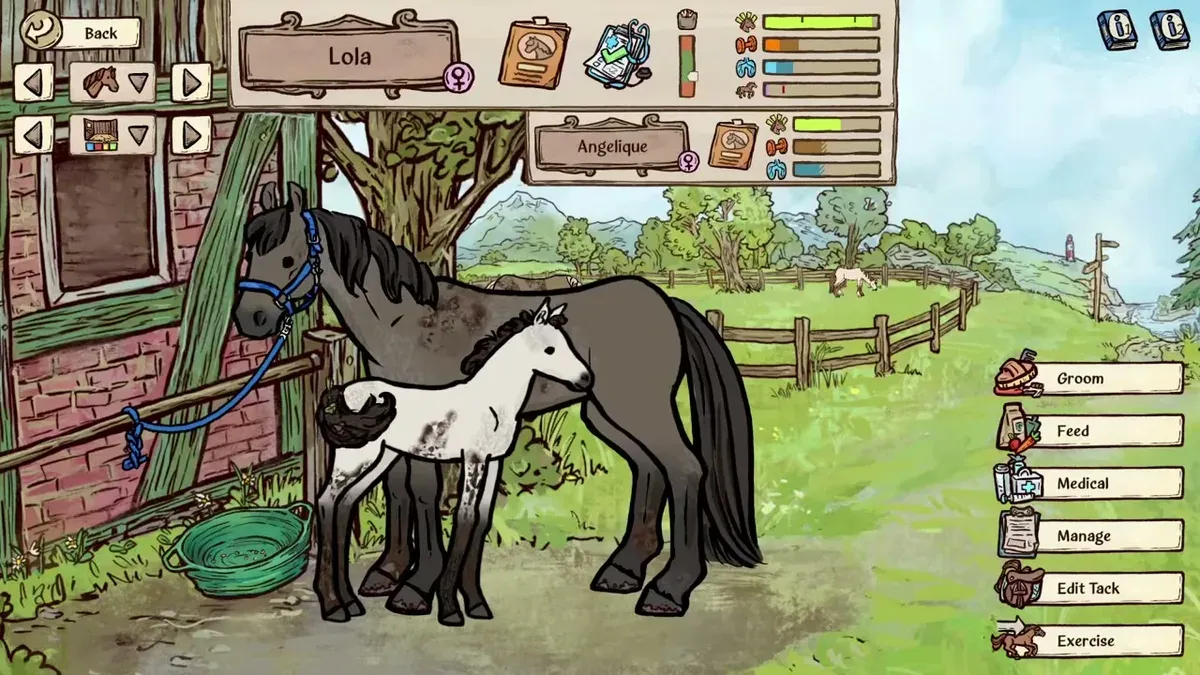
How leading a horse works
Horses of Hoofprint Bay leading horse training puts you on foot, watching your horse’s reactions as you approach something frightening. Recognizing curiosity and worry matters because pushing a tense horse forward can cause it to bolt. This Horses of Hoofprint Bay leading horse guide explains the confirmed training controls, how to respond to those reactions, and where ordinary walks fit in.
Updated November 5, 2026, for the global Steam full release, which launched November 4.
The clearest example of leading appears in Confidence Training: the character handles the horse on foot with a rope. The game’s tutorial shows how to approach a scary object, reward curiosity, and retreat when necessary. These details come from the in-game tutorial visible in Rohara’s full-release Confidence Training recording.
Two relevant activities serve different purposes:
| Activity | What it involves | What to focus on |
|---|---|---|
| Confidence Training / desensitization | Leading a horse toward a scary object | Recognizing curiosity, praising, and backing away from worry |
| Going on a Walk | Taking a horse for an outing, with foals able to accompany nursing mares | Choosing the walking activity described for the arena or forest |
If you want to practice handling a nervous horse around an object, Confidence Training is the relevant exercise. If you simply want an outing with your horse or nursing mare, look for Going on a Walk.
Choosing the activity first also helps you interpret the controls correctly. A key labeled for riding does not automatically describe every action available while your character is on foot.
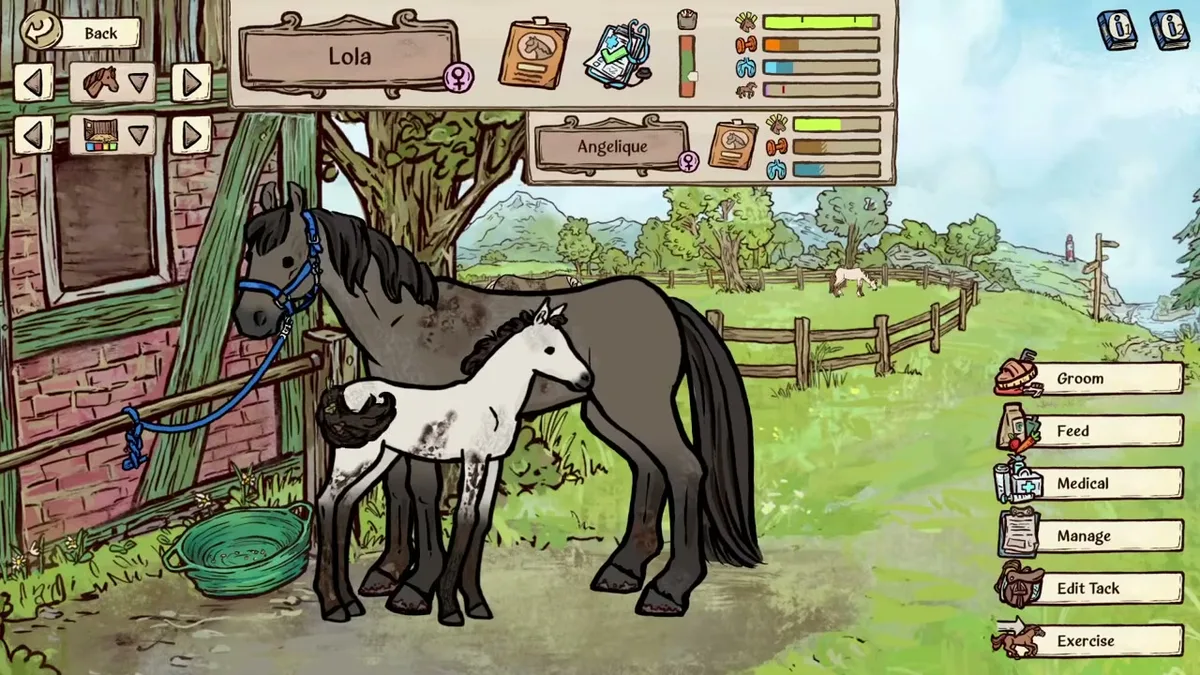
Game reference image. Image source.
Full-release gameplay and in-game handbook: Horses of Hoofprint Bay FULL RELEASE! Starting Our Horse Stable! 🐎 — Rohara, November 4, 2026. English-language reference footage. Specific handbook claims link to their observed timestamps; other uses are general game reference, not a device benchmark or proof of a bug fix.
Leading horse controls
The Confidence Training tutorial displays two particularly useful commands: S for Praise and A for Back up. Those are the bindings shown in the full-release recording; controls can be rebound, so your own settings may differ.
| Context | Action | Binding shown |
|---|---|---|
| Confidence Training tutorial | Praise | S |
| Confidence Training tutorial | Back up | A |
| Riding controls screen | Praise | S or Down Arrow |
| Riding controls screen | Slower | A or Left Arrow |
The broader bindings are visible in Rohara’s Settings/Rebind Controls recording. Keep the context column in mind: the riding screen lists alternative keys, while the leading tutorial specifically displays S and A.
For example, A is labeled Slower in the riding settings and Back up in the confidence tutorial. Read the current activity’s prompt instead of assuming the action has exactly the same meaning everywhere.
Before working through a scary object:
- Check the displayed Praise and Back up prompts.
- If your keys differ, consult Settings/Rebind Controls.
- Use the horse’s reaction to decide when to praise or retreat.
- Follow the activity’s movement prompts when approaching.
The available tutorial observations do not establish a separate forward-leading key, so this guide does not assign one. The useful confirmed inputs are the ones that let you reward curiosity and create distance when the horse becomes worried.
Learning those two responses gives you a practical starting point without having to memorize the entire riding controls list.
Build confidence by responding to your horse
The central leading horse technique is to find a distance where the horse can investigate the object, then work closer gradually. Watch what the horse is doing before deciding on your next input.
The Confidence handbook visible in Rohara’s recording of the in-game book describes a lowered, investigating posture and a distinctive snort as signs of curiosity. A tense, worried reaction calls for more distance.
| Reaction or event | What the handbook describes | Your response |
|---|---|---|
| Curious investigation | The horse lowers its posture to inspect the object and makes a distinctive snort | Praise |
| Worried or tense behavior | The horse is uncomfortable with the approach | Back away and give it time |
| Continued pressure while worried | Pushing forward can cause a bolt | Stop pressing forward and create space |
| Passing the scary object | Confidence improves after getting past it | Treat passing the object as the exercise’s objective |
A practical sequence follows directly from those instructions:
- Approach gradually. Pay attention as the horse reacts to the object. Your immediate aim is to find a distance where it shows curiosity.
- Recognize investigation. Watch for the lowered inspection posture and listen for the distinctive snort described in the handbook.
- Praise the curious response. Use S if your binding matches the tutorial, or your rebound Praise key.
- Back away from worry. If the horse becomes tense, use the displayed Back up command and give it space and time.
- Resume the gradual approach. Continue responding to curiosity and worry as you work toward passing the object.
For example, suppose the horse investigates an object, receives praise, and then becomes tense as you approach more closely. That new reaction changes your next action: back away instead of continuing forward simply because the previous moment went well.
This makes observation part of every approach. There is no supported universal distance or fixed number of praises that guarantees success for every horse and object.
The handbook connects confidence improvement with passing the scary object. It does not provide a verified numerical reward in the available observations. Focus on completing the approach while responding to the horse, rather than expecting each press of Praise to produce a known number of points.
Take a horse, nursing mare, or foal for a walk
For a regular outing, look for Going on a Walk among the activities associated with the arena or forest. The developers described those locations in their official update introducing walks and desensitization, published August 12, 2026.
That announcement says horses can go for walks and specifically highlights nursing mares because their foals can accompany them. The October demo announcement subsequently included walking with or without foals among its additions.
For players exploring leading horse activities, this gives walking a clear purpose beyond the scary-object exercise: an outing can include a mare and her foal. You do not need to interpret every scene with the handler on foot as confidence training.
Keep these distinctions in mind when choosing an activity:
- For a regular outing: look for Going on a Walk.
- For a mare-and-foal outing: the developers specifically describe foals accompanying nursing mares.
- For practicing reactions to scary objects: use Confidence Training and its tutorial prompts.
The walking announcements describe the activity and companions, but they do not establish a complete launch-version menu path or unlock checklist. Use the activity names to identify the relevant option in your save.
They also do not establish that an ordinary walk gives the same confidence reward as successfully passing a scary object in desensitization. Choose the exercise that matches your immediate goal, and use its own instructions to understand what you are training.
Understand older demo advice before applying it
Some leading horse searches bring up discussions written before walking and desensitization were added. Their dates matter because confidence training changed during development.
| Older material | What it describes | How to interpret it |
|---|---|---|
| February demo discussion | Players reported raising confidence by praising after requested gait changes | Player experience from the earlier demo |
| May stable-and-field discussion | A player could place horses outside the marked area; a reply called it a demo bug | Community reports about yard placement |
| August developer update | Confidence was being reworked, with desensitization added | Official development context |
| November 2 Playtest notes | Tutorial fixes and confidence-course adjustments | Historical Playtest changes, not a launch version number |
In the February confidence discussion, player experience included using S shortly after a requested gait change. Another participant quoted the demo’s training book to explain that behavior.
Those reports are useful historical context, but claims about building confidence extremely quickly belong to that earlier demo. The August developer update explicitly described changes intended to slow confidence progression and introduced the scary-object exercise.
The current tutorial also gives praise a clear role during curious investigation. Consequently, an older player’s impression that praise works only after gait changes should not define how you handle the full-release desensitization exercise.
A separate May discussion about placing horses outside the stable or field contains community reports of a demo placement bug. A reply said affected horses returned to the stable when the scene reloaded. That report does not establish a free-roaming or rope-leading system.
Likewise, historical Playtest fixes for freezing during the desensitization tutorial do not prove that every similar symptom in the released game has the same cause. Distinguish a horse reacting to an object from an interface or tutorial problem before applying advice from an older build.
FAQ
Can you lead a horse on foot in Horses of Hoofprint Bay?
Yes. leading horse gameplay is visible in the full-release Confidence Training tutorial, where the handler uses a rope while standing on foot. The tutorial shows Praise on S and Back up on A. Those bindings are adjustable, so follow the prompts in your own game.
Is there a hotkey for leading a horse directly out of the stable?
A universal stable-leading hotkey is not verified by the current evidence. The confirmed controls belong to Confidence Training. For an ordinary outing, look for Going on a Walk in the arena or forest activities. Older community reports about dragging horses outside marked yard areas concern a demo bug.
Can a foal come along when you walk its mother?
Yes—the developers specifically describe foals accompanying nursing mares on walks. Their August announcement identifies the arena and forest as walking locations, and the October demo announcement includes walks with or without foals. Those descriptions concern accompanying the mare; they do not establish a separate foal-leading control.
How much confidence does leading horse training give?
The full-release handbook associates confidence improvement with passing a scary object, but the available observations do not establish a numerical reward. Praise curiosity, back away when the horse becomes worried, and approach gradually. A fixed number of key presses or a guaranteed confidence gain per session has not been verified.
What should you read next?
- Horse Training & Confidence Guide
- How to Praise Your Horse
- Jumping Timing, Gaits & Strength
- Riding Lessons & Correct Posture
Return to Training & Lessons or the wiki homepage to choose another topic.
Related Articles
training
Horses of Hoofprint Bay: Horse Training & Confidence Guide
Build strength, endurance, and confidence with practical guidance on desensitization, praise, gait warnings, and community reports about bucking.
training
Horses of Hoofprint Bay: How to Praise Your Horse
Learn the praise controls, when to reward gait changes, and how to build confidence during desensitization in Horses of Hoofprint Bay.
training
Horses of Hoofprint Bay: Jump Indicator & Takeoff Help
Understand jump markers, strength warnings, riding controls, and gait choices, with full-release guidance and clearly labeled demo tips.
Was this helpful?
Thanks for the feedback!