
Horses of Hoofprint Bay: Boarders: Contracts, Care & Feeding
Learn how to accept boarders, manage feeding and daily care, and complete schooling contracts in Horses of Hoofprint Bay's full release.
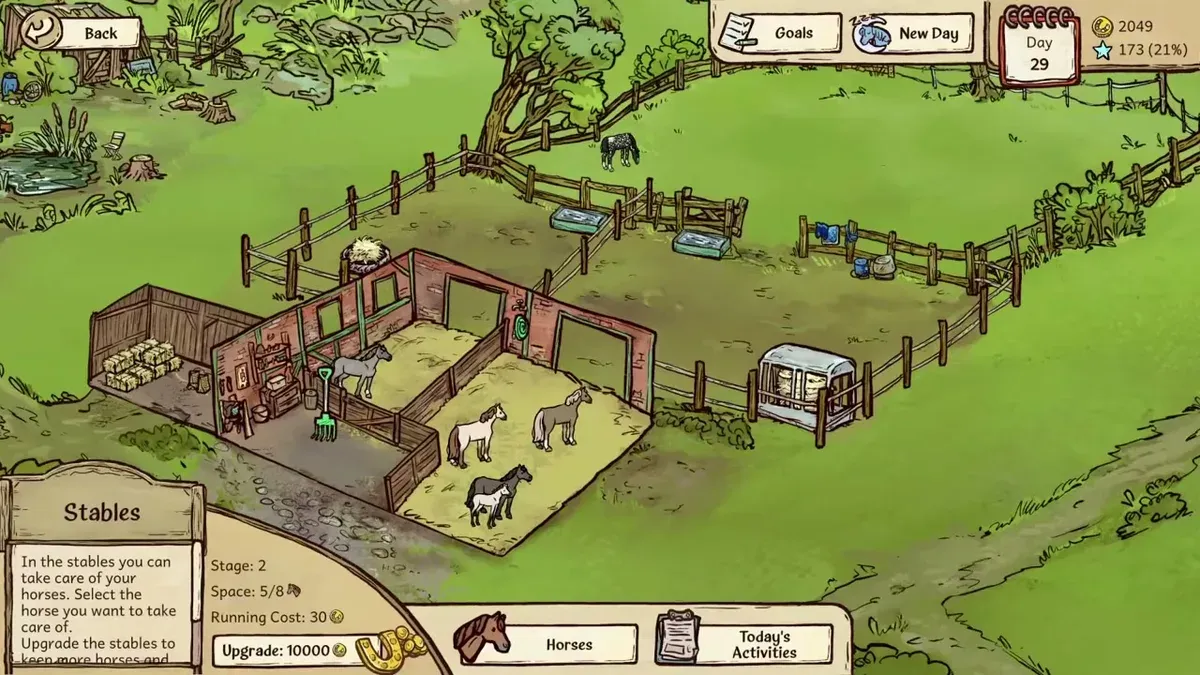
How to Accept Boarders and Choose a Contract
Horses of Hoofprint Bay boarders can earn your stable money, but each contract brings a different job. Understanding those duties helps you plan feeding, grooming, and training before taking responsibility for another horse. You accept Horses of Hoofprint Bay boarders in the Main House office, where the owner’s contract determines what you must provide during their stay.
This guide covers the global Steam full release, launched November 4, 2026, with handbook evidence dated November 5. The boarding rules come from the in-game How to Make Money book visible in Rohara’s full-release recording.
Boarders stay for several days. Before accepting one, identify the contract type and read its requirements carefully.
| Contract type | Your responsibilities | Main planning concern |
|---|---|---|
| Part board | Provide hay or pasture | Maintain access to roughage throughout the stay |
| Full board | Feed and brush daily, and monitor medical needs | Account for the owner’s exercise when managing grain |
| Schooling | Provide care and achieve the requested training goals before the stay ends | Fit training into the horse’s daily exercise limits |
These are contract categories described in the full-release handbook. They give you a useful way to judge how much attention each offer needs.
Part board is a sensible starting point if you are still learning the barn routine, because its listed duties are simpler. Full board adds daily individual care. Schooling adds a deadline and a measurable training obligation.
For a schooling offer, compare the requested improvement with the time available and the horse’s endurance before accepting. A contract that fits comfortably alongside your existing horses is easier to manage than one that requires squeezing extra training into every day.
Exact payment rates, universal stay lengths, and a complete boarding unlock sequence are not established by the handbook observations used here. Check the offer in your game for those details.
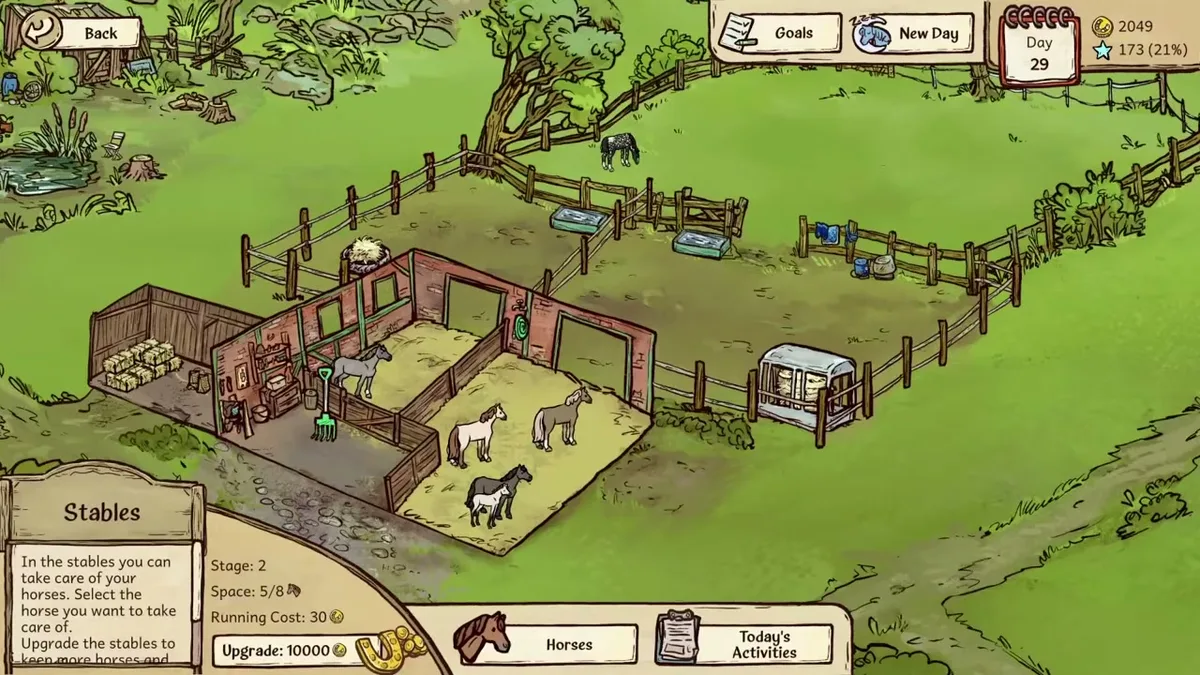
Unaltered gameplay still from JayPlays’ full-release video. General visual context, not proof of an undocumented mechanic. Image source.
Full-release gameplay and in-game handbook: Horses of Hoofprint Bay FULL RELEASE! Starting Our Horse Stable! 🐎 — Rohara, November 4, 2026. English-language reference footage. Specific handbook claims link to their observed timestamps; other uses are general game reference, not a device benchmark or proof of a bug fix.
Feeding Boarders: Roughage, Grain, and Body Condition
Feeding boarders means checking both their access to roughage and their individual body condition. A stocked hay rack does not tell you whether a working horse needs additional grain.
The full-release Horse Care handbook explains that horses need hay or pasture, while harder work increases the need for grain to prevent weight loss. It also shows how to deliver food and water in the care-book segment of Rohara’s recording.
| Need | How to provide it | What to check |
|---|---|---|
| Hay | Drag hay from storage to stable or paddock racks | Roughage is available where the horse is kept |
| Pasture | Provide access to pasture as a roughage source | The horse actually has access |
| Grain | Select the individual horse and feed it | Body condition and workload |
| Water | Drag a bucket to the water tub | The water supply; later upgrades offer a hose or automatic filling |
For full-board horses, the owner handles exercise. Your feeding decisions still need to account for that activity. A horse can therefore need grain even when you have not personally ridden it.
The Horse Stats & Training handbook describes body condition as weight: work reduces it, and grain restores it. Too little condition can lead to malnourishment; too much can lead to overweight and laminitis. Those mechanics are shown in the full-release stats-book segment.
Use the horse’s condition to guide feeding rather than applying the same scoop count to every boarder. Recheck after advancing the day so you can see whether your routine is keeping pace with its workload.
Why Older Advice Says to Feed Into the Middle of Green
Player experience from the February demo period suggested that feeding only to the bottom of the green condition range could leave boarders hungry the following morning. Some players reported better results around the middle of green; another reported continued hunger despite doing that. A contributor also suggested checking the office horse overview’s body-condition change indicator. These are community reports about hungry board horses, not a verified launch feeding formula.
The practical takeaway is to watch condition over successive days. The current handbook supports adjusting grain for workload, but it does not establish a fixed number of scoops or a guaranteed position within the green range.
A Daily Care Routine for Boarders
Daily care for boarders should follow the owner’s contract, with extra preparation whenever you are responsible for riding or training.
Full board explicitly includes daily feeding, brushing, and medical monitoring. Schooling requires care alongside progress toward the training goal. Build your routine around those obligations so a training session does not distract you from basic upkeep.
| Check | Action supported by the care handbook | When it matters |
|---|---|---|
| Food and water | Supply roughage and water; assess individual grain needs | During daily care |
| Coat | Curry away dirt and brush | Daily brushing for full board; preparation for riding |
| Saddle area | Brush the hair smooth | Before riding |
| Hooves | Remove stones | Before work |
| Injuries | Disinfect superficial wounds; use the in-game vet for more severe conditions | When checking the horse’s health |
The distinctions matter. Brushing the coat does not replace checking the hooves, and supplying hay does not replace assessing body condition. Likewise, basic wound treatment does not cover every medical problem the game can present.
A useful routine is to check supplies first, complete individual care, and then prepare any schooling horse for its session. Afterward, review its condition and training progress before ending the day. This is a suggested workflow built around the handbook’s requirements, rather than a mandatory sequence.
Keep your attention on the actual contract. The handbook confirms that full-board owners exercise their horses; it does not make you responsible for completing schooling goals on those contracts.
Training boarders Without Exhaustion
Schooling contracts for boarders require both care and the requested training result before departure. Keeping the horse healthy is necessary, but it does not replace reaching the owner’s goal.
The exercise bar is particularly easy to misread: it represents work already used today. Passing its red threshold produces exhaustion the following day. Greater endurance allows more daily exercise, according to the full-release stats handbook.
| Training consideration | Confirmed handbook rule | Practical implication |
|---|---|---|
| Exercise bar | Tracks work used that day | Review it before adding another session |
| Red threshold | Exceeding it causes next-day exhaustion | Avoid trying to recover lost progress through excessive work |
| Endurance | Higher endurance permits more daily exercise | Allow a slower schedule for a horse with lower endurance |
| Overnight field time | Counts as some exercise | Include turnout when considering overall activity |
| Body condition | Work reduces weight; grain restores it | Review feeding as training workload changes |
Start working toward the contract goal early enough to observe how much progress the horse makes without exhausting it. After each session, compare the remaining goal with the days left.
For example, if a schooling horse is already close to its red exercise threshold, another session could create exhaustion tomorrow. That makes a last-minute push a poor substitute for planning across the stay.
There is no verified universal schedule such as “two sessions daily” or a fixed number of days needed for every schooling horse. Endurance and the requested goal matter, so use the individual horse’s values.
The general training handbook also links insufficient exercise with an explosive state. However, that general rule should not be turned into an instruction to manually train every boarding category. For full-board contracts, the boarding handbook specifically assigns exercise to the owner.
Choosing Manageable Contracts and Understanding Older Advice
When choosing boarders, compare the obligations with the care and training you can reliably provide. The confirmed contract differences support judging workload; they do not establish which category delivers the highest profit.
Before accepting an offer, review:
- Daily duties: Can you provide the feeding, grooming, and monitoring required?
- Training goal: For schooling, what improvement must happen before departure?
- Exercise capacity: Does the horse’s endurance allow a comfortable training schedule?
- Feeding demands: Have you accounted for work done by either you or the owner?
A simpler contract can be a better fit while you learn how condition changes overnight. As your routine becomes dependable, schooling offers become easier to assess because you have a clearer sense of the attention they require.
Failed Goals and Early Cancellation
Older patch notes contain relevant boarding changes, but their version context matters. The official Playtest patch history records longer possible stays for low-endurance boarders in v0.2.16 and some boarding payment for failed training contracts in v0.2.18. Earlier v0.2.7 notes describe removing a prestige penalty when canceling schooling after its goal was reached.
Those entries document Playtest behavior. They do not independently confirm the full release’s payment amounts, cancellation consequences, or build number.
Treat the current contract and any confirmation message in your game as the decision point. Avoid budgeting around an assumed failure payment or ending a completed contract early solely because an older guide says cancellation is harmless.
FAQ
Where Do You Accept boarders?
Accept boarding clients in the Main House office. The full-release money handbook describes stays lasting several days, with responsibilities determined by the owner’s contract. Read whether the offer is part board, full board, or schooling before committing.
How Much Grain Should a Boarder Get?
There is no verified universal scoop count. The current care handbook says working horses need extra grain to prevent weight loss, while the stats handbook warns against excessive body condition. Adjust feeding to the individual horse’s condition and workload, including exercise performed by a full-board owner’s horse.
Do You Have to Ride Full-Board Horses Yourself?
The boarding handbook says the owner exercises a full-board horse. Your listed duties are daily feeding and brushing, plus monitoring medical needs. Schooling is the category that adds responsibility for achieving training goals before the stay ends.
Can boarders Become Pregnant?
Community reports from October 24–26, before launch, describe a boarded mare becoming pregnant while sharing a field with a stallion. A reply attributes this to a chance of field pregnancy. The October discussion about boarded mares is demo-period player experience; the current handbook observations here do not confirm that behavior for the full release.
What should you read next?
- Stable Upgrades & Breeding Lab
- Where to Buy Feed & Hay
- Stable Chores & Staff Assignments
- Max Horses & Stable Capacity
Return to Stable Management or the wiki homepage to choose another topic.
Related Articles
guides
Horses of Hoofprint Bay: Money Making Guide
Explore riding lessons, competition prize money and home-bred horse sales in Horses of Hoofprint Bay. Plan income alongside horse care and stable expansion.
stables
Horses of Hoofprint Bay: Equipment, Tack & Care Tools
Explore Horses of Hoofprint Bay equipment, tack colors, care tools, Prestige shop variety, and dated community tips for tack changes and hoof boots.
stables
Horses of Hoofprint Bay: Where to Buy Feed & Hay
Find the community-reported feed shop in Horses of Hoofprint Bay, learn where to select hay, and understand what remains unconfirmed at launch.
Was this helpful?
Thanks for the feedback!